Utah's 5% Tint Variance Rule, Explained: What It Actually Means for Your Ticket
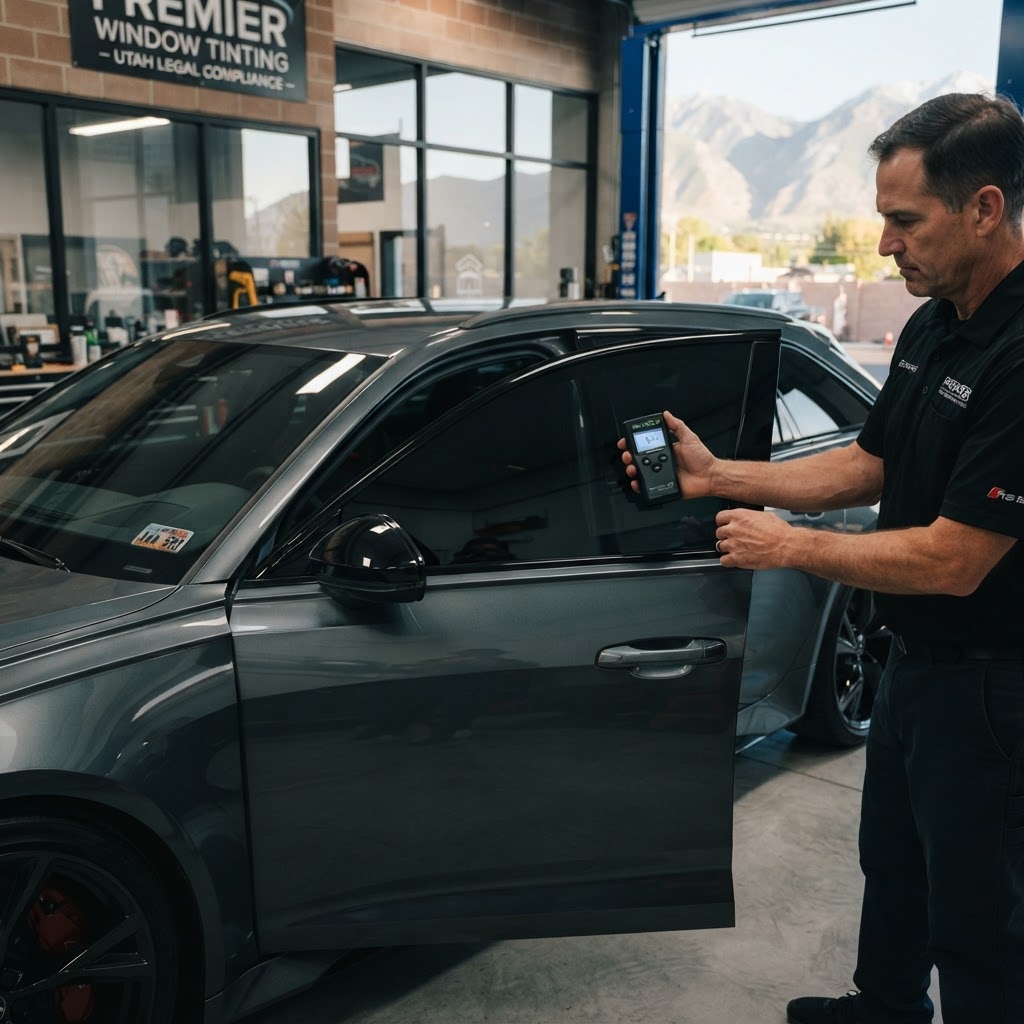
Utah's 5% Tint Variance Rule, Explained
If you've ever shopped for window tint in Lehi, Orem, or Eagle Mountain, you've probably heard something like: "Don't worry, there's a 5% tolerance." But what does that actually mean legally — and could it save you from a ticket, or lull you into a false sense of security?
Let's break it down using the actual law.
What Utah Law Actually Requires
Under Utah Code 41-6a-1635 (effective May 7, 2025), here's what's required for passenger vehicles:
- Windshield: Must allow at least 70% VLT (visible light transmittance). Tinting is only permitted along the top edge — no more than 4 inches down, or to the AS-1 line, whichever is lower.
- Front side windows: Must allow at least 35% VLT.
- Rear side windows and rear window: No minimum VLT — any darkness is legal.
- Metallic or mirrored appearance: Not allowed on any window.
- Side mirrors: Required on both sides if any rear window is tinted.
Violations are classified as infractions — not moving violations — and cannot result in the revocation of your registration or driver's license.
So What Is the 5% Variance?
The law states that when a peace officer uses a meter to measure your front window tint, a variance of no more than 5% is observed. In plain terms: the officer's meter is expected to read your tint within 5 percentage points of the legal threshold.
This means if your film is installed at 35% VLT (right at the legal limit), an officer's meter might realistically read anywhere from 30% to 40% due to instrument variance, glass type, or film aging. The law acknowledges this measurement reality.
What the 5% Variance Is NOT
Here's the critical point many drivers in American Fork, Highland, and Saratoga Springs misunderstand: the 5% variance is not a legal buffer that lets you run 30% tint on your front windows. The legal minimum is still 35% VLT. The variance simply accounts for meter accuracy when enforcement occurs — it's not an invitation to go darker.
If you deliberately install 30% film on your front windows, you are below the legal limit and can be cited regardless of the variance language.
How Officers Measure Tint in Utah County
Officers use handheld tint meters — devices that measure how much light passes through your window glass and film combined. The reading accounts for both your factory glass and any added film. That's an important detail: factory glass already blocks some light, so a film rated at 35% by the manufacturer may measure lower once it's on your car.
This is especially relevant for residents of Provo, Pleasant Grove, and Alpine who drive vehicles with slightly tinted factory glass. Your installer should be measuring the combined VLT — not just the film's standalone rating.
How to Stay Legal and Avoid the Headache
The easiest way to avoid a citation in Utah County is simple: work with an installer who measures combined VLT before and after installation. At King Romer, every job includes a check to make sure your front windows meet the 35% minimum after accounting for your factory glass.
Our Basic Coverage package uses INSULEX True Carbon IR film — a clean, reliable option that performs well within legal limits while blocking infrared heat. Our flagship Royal Protection package uses X Supreme Nano Ceramic film with a lifetime warranty, giving you maximum heat rejection and UV protection without pushing the legal boundary.
We serve Eagle Mountain, Saratoga Springs, Lehi, American Fork, Pleasant Grove, Alpine, Highland, Orem, and Provo — and we know Utah tint law inside and out.
Bottom Line
The 5% variance is a measurement tolerance for officers — not a loophole for darker tint. The law is clear: front side windows must allow at least 35% VLT, per Utah Code 41-6a-1635. Understanding this distinction could save you an infraction and keep your windows looking sharp and legal.
Ready to tint the right way? Get a quote today or reserve your install spot — we'll make sure your vehicle is dialed in perfectly.